Returning to reading
I’ve been reading a lot in 2025. Whenever possible, I’ve tried to replace looking at my phone with looking at a book, a physical book to be more precise. I think there are enough content creators who have said and re-said all there is to say on moving off your smartphone.
- “Stop doomscrolling.”
- “Reclaim your time”.
- “Revive your attention span.”
- “Learn to read again.”
Or some combination thereof. I’m not in disagreement with any of it. I don’t remember which was the first youtube video I watched but the angle that worked on me was anti-capitalist. “The oligarchs make money out of making you miserable, don’t give them more rope to hang you with!” At the time I already knew I was depressed enough to begin with, so I decided to switch my primary handheld timesink for another. “Yeah!”, I said, “Fuck Mark Zuckerberg, he’s colonized enough of my headspace.” At least with a book, the length of the transaction between the author and myself lasts only the entire duration of however long it takes for me to purchase the book. After that, the author will not requisition anymore money from me until the next time I deem their services needed. They are not surreptitiously waging psychological warfare against me, cryptomining every last bit of my attention and depositing little noxious turds of anger and anxiety in their wake.
“Yeah, books are the way humans were meant to process information. We’ve had books for so long at this point it’s part of our evolution. Books are written into our DNA. You can’t go wrong picking up a book.”
But you already know that’s not true, reader. There are tons of bad books out there, just as there are bad movies, bad 7 second shortform videos, bad teachers, and bad bloggers. Books can also be weapons of psychological warfare, and just because it’s not on a screen doesn’t mean that it can’t be effective.
John Stossel
Probably many of the young ones don’t know who that is. To be fair, I barely know who he but he used to be a Fox News host in to 90s into the 2000s and was (is?) a relatively well known libertarian. When I was 12 years old, my dad bought me one of his books and I read it cover to cover probably three or four times. Here is the cover for said book:
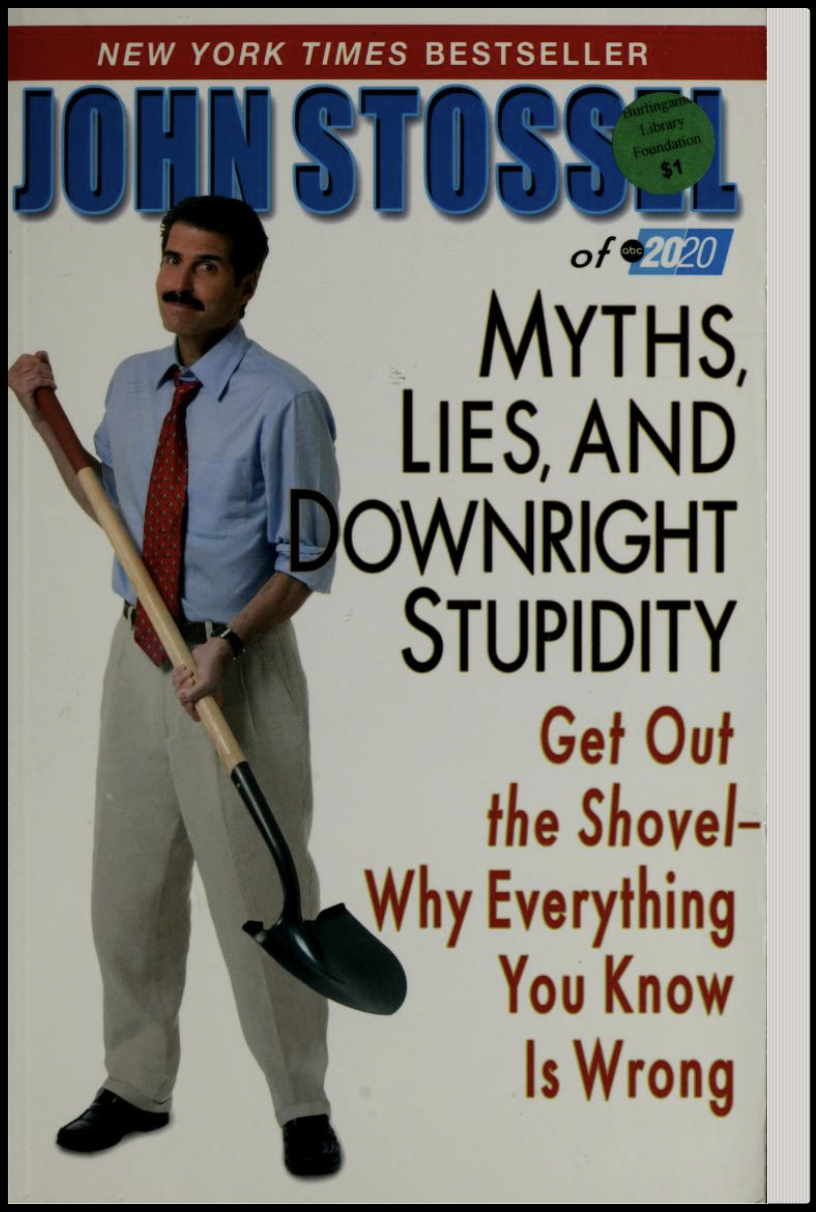
The cover is everything you would expect it to be from a man who believes he is always the smartest one in the room. Unfortunately, I do not have my childhood copy of this book anymore, but perhaps I can paint the reader a picture of the influence this book had over me.
I was in seventh grade at the time, the age where I am now going between different assigned classrooms all the time to attend classes that were just called “Math” or “Language Arts”. The teacher who taught “Science” was a very kind, hippy-like woman with a shrubby mass of curly red hair. Class was usually quite engaging, and at one point we began talking about genetic differences bewteen people. As these things go, the converation began to get quite touchy. At some point, I interjected that the actual proportion of different base pairs between myself and my partner, an Israeli girl, were small and people were all basically the same. To which the response was, that was true in some senses and that message can have a nice interpretation, but we should be careful not to acknowledge that different people can go through different hardships. We can’t say everyone has a fair shake because the playing field is tilted. Why, women on average make less than men, my teacher said.
I hit back with “If women make less than men for the same work, why would anyone ever hire a man? Women aren’t paid less, they just want different things out of work.” That was a John Stossel classic right there, got to give credit to the News Corp GOAT for that one. Basically, I was right in lockstep with John Stossel’s main contention that there is no gender paygap and women may make less money because they’re too busy asking for maternity leave or something (this is where I wish I did have the book so I could accurately quote what was said, but I remember maternity leave being mentioned in there because that was the first time I had every heard to term).
In another classroom exercise, this time over in Social Studies, we were having a mock debate on clean energy incentives (this was circa 2006). The class arrived at a 23-1 decision to fund clean energy initiatives with the goal of fully decarbonizing by some predetermined date, possible this year for all I remember. And the one “Nay” in the class was this poor apostle of St John Stossel. “Think of the debt we would have to take on in order to fund this plan? Besides our whole life is based on fossil fuels, we can’t throw it all away.” I beeseeched. But it was too late, and the fake legislation was ratified to some light applause from the students.
Fairly soon I was known as a young libertarian, but since few middle schoolers knew what a libertarian was, I was more likely to be referred to as the class elitist. The reader should be assured that after subsequent years of schooling, reading other books, and debating other students, I have successfully been indoctrincated into something closer to data-supported reality. It was quite a revelation when I learned how much my trusted sensei John Stosell-san had misled me, typically by lies of omission, on many of the things I grew up believing. I have changed many of my opinions since seventh grade, althought it appears there’s still something in my mannerisms that suggest to people that I protest outside a Planned Parenthood or something. Ten years after seventh grade, I found that several people independently thought I was a Republican and had voted as such during the 2016 election. It is a life mission of mine to figure out what gives people this affectation, but until then hopefully this writing will serve as a public record of which side I fall on.
In any event, nobody can tell that a book can’t be a powerful weapon in the modern day. John Stossel himself essentially remote controlled the mouth of young Asian boy from hundreds of miles away. I stopped reading books for pleasure around the time that I graduated from college and the only books that I picked up afterwards were mainly textbooks mainly related to statistics. This was due to several factors, but I would be lying if John Stossel’s betrayal didn’t count high on that list. There were simply as many books as there were human beings on Earth, each one carrying the author’s flaws, faults, biases, and blemishes. What as the point in trying to learn from any book other than a textbook? I can avoid being lied to through text if I avoid reading altogether.
Perhaps it was naive to think I had already fulfilled my lifetime quota of being hoodwinked by a stack of paper. That by eliminating reading, I had cut off any chance of being psychologically jiujitsu’d by some a novel that was actually about the pro-life movement (for some reason I keep mentioning this topic - perhaps this is why people really think I am a right-winger). The truth is a lifetime is a long time. As with most promises of this nature, eventually I was to return to reading books, fuck the tech oligarchs after all. However, I did so with one of the worst mentalities one can have when embarking on a new activity: that I have missed out on years of reading and needed to work overtime to compensate.
I blame BookTube
This mentality resulted in a critical error. As with many new hobbies, I immediately went to YouTube to sample internet opinion on what to read. YouTube (a site that frankly I spend too much time on and completely goes against my “principled” stand against tech oligarchs since it too is run by one Mr. McSundar Pichkinsey) turned out to be a hotbed of book readers, going by the moniker “BookTube”. As soon as I happened upon this subculture, the algorithms took hold and soon I was met with a deluge of BookTubers, with endless opinions to sample from. Assembling a list of collective recommendations was easy enough, it was keeping the list to a manageable length that proved difficult. After a single afternoon that could have been spent on reading itself, instead killed by watching a dozen influencer discussing their “TBR” (funny how something supposedly fun and innocent can be bestown such a dry acronym that would not be out of place in an MBA networking seminar) in their grandiose home libraries, I had a list in hand. For illustration, I will share a sampling of these books below:
- The Count of Monte Cristo
- Lonesome Dove
- The Infinite Jest
- The Brothers Karamazov
- The Stand
Now, I have nothing personal against any of these books because frankly I still haven’t read any of them yet. I am willing to bet most of them are good (controversial I know), or at least have good parts that were worth digging for.
My issue with this list is that it’s not my list.
This is simply a list of classic novels, assembled and arranged as such because everyone should read them. The kind of thing a Penguin mid executive would throw together as a Literary Classics SetTM, and sell for hundreds of dollars from autumn to late winter. They have stood the test of time, they have formed the bedrock of Western cultural canon, and if you want to understand the world better, there’s no better place to start than here. While this is a fine argument for a person wanting these things, a true scholarly type let’s say, that was not who I was in the moment.
There would have been a time in my life where I would gladly read the classics just because someone, some individuals of authority, declared that these books were in a special category by themselves. “Smart people read these,” I would have monologued to myself “and we want to be smart. Smart and respected and publicly acknowledged as such. To Dumas it is!” I like to think that sun has set for me, and to read such a list now would take a significant amount of mental strain that would not be fruitful when taking up an activity that should be fun and relaxing. The things I find interesting are specific, American and Chinese history, narrative nonfiction, evolution of language, short stories,
I learned this first hand during the month of August, when I tackled one of the classics on a whim, just to say I had read it.
A Brief, Uncivilized Review of Anna Karenina
My goodness, what a heavy, boring book. At least to me, doubtless there are many who adore this novel and the internet is replete with people (and they are all real people, since I assume the Tolstoy fandom has no reason to enlist a botnet to astroturf the public) who claim this is their favorite novel of all time. I have no ill will towards any of these people, and frankly I am not interested in debating the Anna Karenina’s place in the Pantheon of literature. It is a classic novel, treasured by dozens, if not millions of people thoughout time and space, and nothing I say will change that.
But for my own sanity, I just have to express my confusion with the whole idea of it being a novel. The story is relatively straightforward enough. A beautiful, intelligent, strong countess with a sensible husband and beloved child begins an extramarital affair with a dashing military man. The couple is eventually found out and they go abroad, the husband refusing a divorce, but at least they can enjoy their love without the physical imposition of their high society.
Various characters are spurned or hurt in the chaos, there’s another girl for example who sough the military man, and another man who sought that girl. The husband and suitor meet at one point when the countess is on her apparent deathbed and peace is agreed upon for her dying moments, only for her to make a miraculous recovery and the amends are quickly broken. The husband refuses a divorce again and again, and witholds the beloved son from seeing the countess, who has to sneak in to her own home to speak with her boy after years abroad. The countess spirals further and further into despair as the various distractions and fancies she used to have no longer ameliorate the feeling that her life is ruined and meaningless. Finally, our heroine has a mental breakdown when she suspects even her lover is on the bring of leaving her, and throws herself under a train.
Now, I’ll admit this is not my typical cup of tea, but I have no outright animosity towards a story based on family drama. However, what I spelled out are the main beats of Anna Karenina’s story in Anna Karenina. Certainly a tale worth telling, but I ended the story wondering why the book over 900 pages long. Surely, this could be addressed in about 500 pages (about the length as Crime and Punishment) and still captured all the details and poetic detail necessary to make a compelling story without overstaying the reader’s generous welcome.
The reason I regret to report is the character Konstantin Levin, a self insert of Tolstoy, and the main character of the novel despite not being on the title. Levin does play a pivotal role in the story, being the suitor and eventual husband of Kitty Shcherbatsky, who was initally sought to be engaged to Anna Karenina’s lover. However, he spend the majority of his time (as well a a singificant portion of the entire book) monologuing on a rainbow of riveting topics such political theories of organizing agricultural communes, motivating peasant servants in his house, and the joy of cutting the grass. Levin quite literally spends about 20 full pages describing a day of scything grass with some Russian peasants aka the Boys. I could not help but roll my eyes everytime Levin aka Tolstoy went on some tangential rant that had nothing to do with the plot or the story of Anna Karenina.
I will admit that the conclusion of the novel, which is basically Levin monologuing about the nature of God and the purpose of his life, was beautiful. I had a similar reaction to the conclusion of Anna Karenina that I had to reading an annotated copy of the Bhagavad Gita, or watching the TV ending of Neon Genesis Evangelion where Shinji dissects his entire life (there’s actually a lot of parallels between Shinji Ikari and Konstantin Levin… interesting topic for a future essay maybe). In all, it was a wonderful conclusion, but the problem is that it’s a wonderful conclusion to an essay on religious philosophy, not a conclusion to a straightfroward drama novel.
At some point, I will reread Anna Karenina but taking detailed statistics on Levin’s various diversions and the pages alloted. The character was literally inserted into the book so that Tolstoy could show off his big throbbing brain, and really souring my opinion of this “classic”, and in turn soured my opinion of reading the classics in general. I’m not here to prove how smart or educated I am, at least not anymore. I’m hear in this library or funky little bookstore or wherever because I want a good time, and that doesn’t mean reading about a guy cutting his grass forever.
This year’s return to reading was a good start, but 2026 should be better. 2025 reading was motivated by pushing away my smartphone and social media, a negative emotion. But 2026 will be reading for reading’s sake. Truly a little bit of everything, not just the Tolstoys but the Stossels too.